Quick answer: If your AC is running but the house will not cool, check five things before you call — the thermostat setting, the air filter, the outdoor unit for ice or debris, the breakers, and the temperature difference between a return and a supply vent. Two of those you can fix in 10 minutes. The rest tell a tech exactly where to start.
It is the middle of an Abilene August. The unit outside is running — you can hear it — but the thermostat says 82 and it has said 82 since noon. Before you spend the afternoon waiting on somebody, here is what to look at yourself, in the order a tech would look at it.
First, make sure it really is not cooling
August in Abilene averages a high near 96 degrees, and the days that break 100 come in streaks. On an afternoon like that, an air conditioner holding the house at 78 is doing its job — it just cannot drag the number down to 72 with the sun on the roof. That is not a broken system. That is physics.
The honest test is not what the thermostat reads. It is the temperature split: hold a thermometer at a return grille, then at a supply vent, and compare. A healthy system drops the air roughly 16 to 22 degrees between the two. Much less than that and something is wrong. Much more, and airflow is probably restricted. Either way you now have a number to give us on the phone, and that saves everybody time.
Check the filter, then check the returns
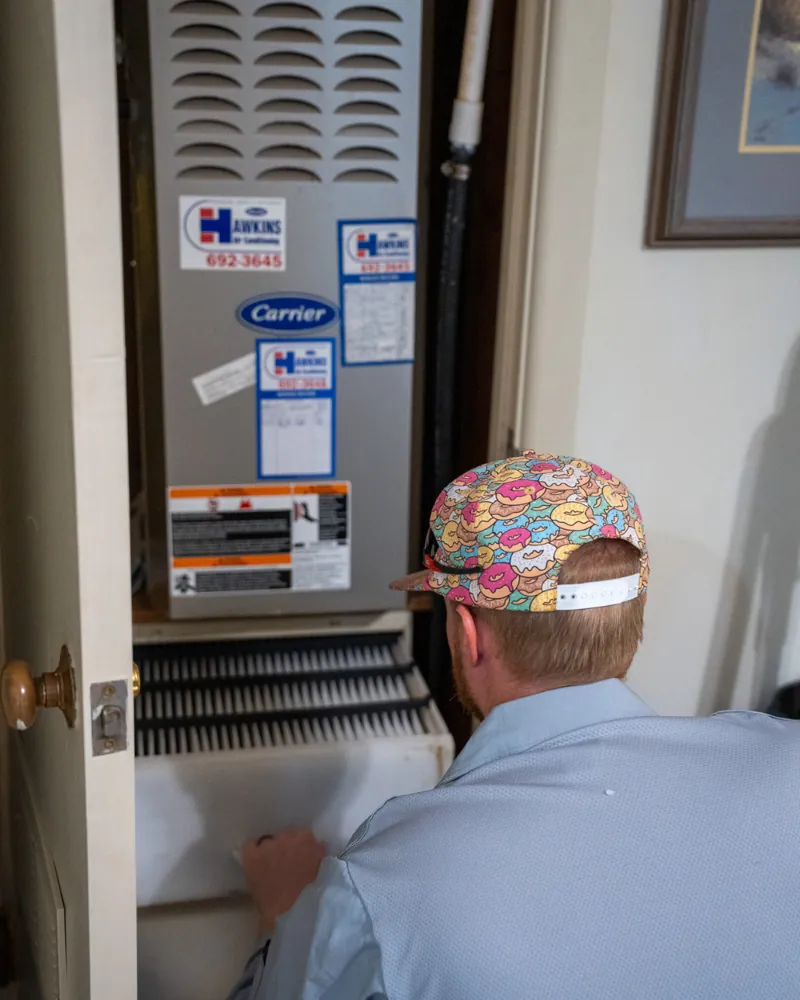
The filter is the cheapest thing on the list to rule out and the easiest one to get wrong. In West Texas a filter grays out fast — blowing dirt off the plains, grass clippings, a caliche road down the way. Once it mats over, airflow across the indoor coil drops, and a coil that cannot get enough warm air across it stops absorbing heat and starts making ice.
Pull it out and hold it up to a light. If you cannot see light through it, replace it and give the system an hour. If it is filthy and the coil has already frozen, a new filter alone will not fix it today — see the ice section below.
Then walk the house and make sure nothing is blocking the returns. A couch pushed against a return grille, or a closet door shut on the air handler, starves the same system a dirty filter does.
Walk out to the outdoor unit
Stand next to the condenser and look and listen. Three things matter.
Is the fan spinning? If the unit is humming but the fan on top is still, shut the system off at the thermostat and call. That hum with no spin is the signature of a failed run capacitor, which is the most common repair we see in the Abilene heat. It is usually a quick, affordable fix — but running the system that way puts the compressor at risk, and a compressor is not a quick, affordable fix.
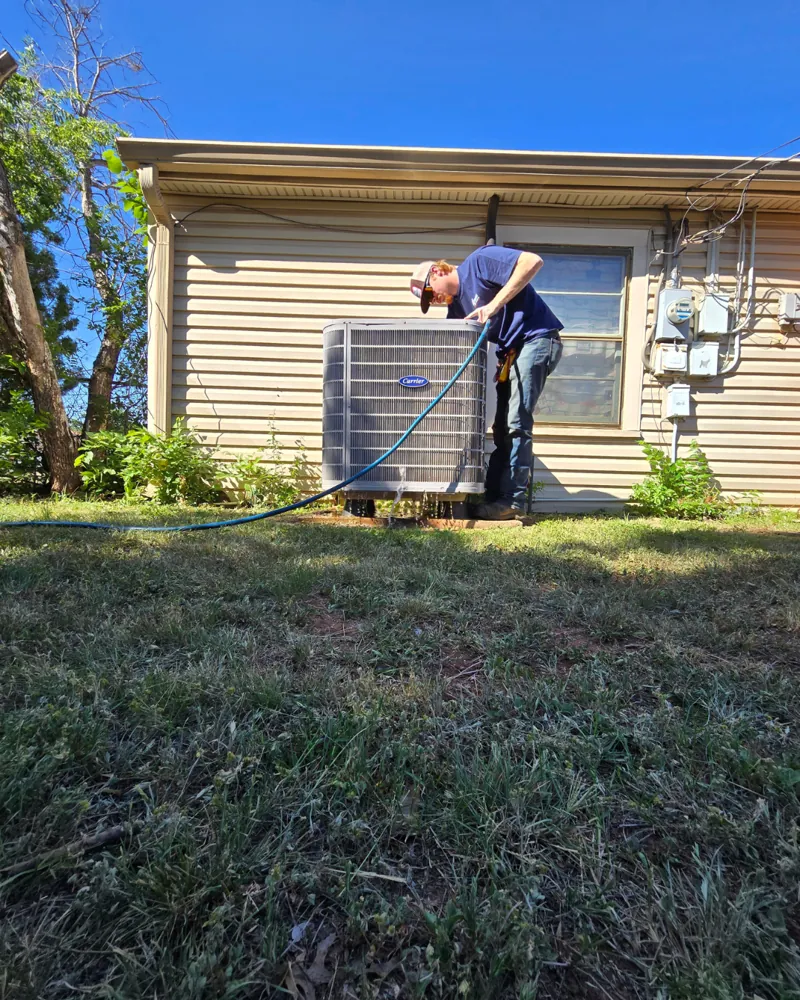
Can it breathe? The Department of Energy recommends keeping the area around the outdoor unit clean and trimming anything growing near it back at least two feet. Around here it is rarely shrubbery. It is Bermuda grass grown up through the base, clippings blown into the coil, or cottonwood fluff matted across the fins. A condenser has one job — dump your house heat into outdoor air. Packed with grass, it cannot.
Are the fins straight? Those thin aluminum fins bend easily — a weed trimmer, a hail season, a stray basketball — and bent fins block airflow the same way a dirty filter does. A contractor can comb them back straight. Do not go at them with a screwdriver.
Rinsing the coil with a garden hose, from the inside out, with the power off at the disconnect, is homeowner work. Anything past that is not.
Look for ice
If you find frost or a solid jacket of ice on the copper line or the indoor coil, stop. An iced-over coil cannot absorb heat, which is exactly why the vents are blowing room-temperature air.
Turn the cooling off at the thermostat and switch the fan to ON. That pushes warm house air across the coil and melts the ice far faster than shutting everything down. Give it several hours — a well-frozen coil does not clear in 20 minutes. Do not chip at it, and do not switch cooling back on until it is completely thawed. Running a frozen system is how a bad afternoon turns into a compressor replacement.
Once it thaws, the ice comes back unless the reason is fixed. Ice means airflow — filter, blocked returns, dirty blower, closed vents — or refrigerant charge. The first you can handle. The second cannot be handled from the driveway.
Do not set the thermostat to 60 — the house will not cool any faster, the system will just run longer. Do not close vents in unused rooms to force air elsewhere; too many closed vents raise pressure and cut total airflow. Do not flip the system off and right back on — give the compressor about three minutes before it restarts. And do not keep resetting a breaker that has tripped twice. A breaker tripping over and over is telling you something.
What we check that you cannot
If the filter is clean, the coil is thawed, the outdoor unit is clear and the fan is turning, and the split is still short, the rest is gauge-and-meter work.
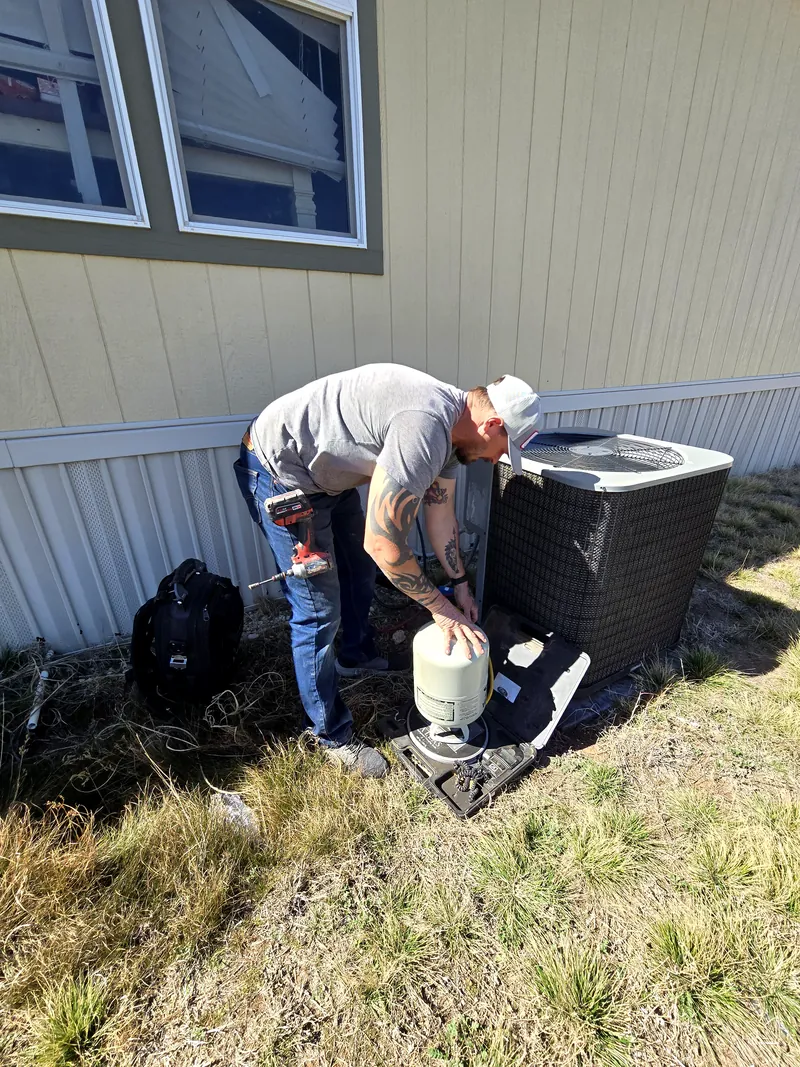
We put gauges on the system and read the actual refrigerant charge, then hunt the leak if it is low. That last part matters. Refrigerant is not fuel and it does not get used up — if the charge is down, it went somewhere, and topping it off without finding the leak just sells you the same repair again next summer. We also measure airflow across the coil, check the capacitor and contactor under load, and look at the blower and the ducts. Then we show you what we found and give you the price before any work starts.
If it is one room that will not cool rather than the whole house, that is a different problem — we wrote about that here.
When to call for AC repair in Abilene
Call if the outdoor fan is not turning, if the coil freezes again after a filter change, if a breaker trips more than once, if you hear grinding or hard clicking from the outdoor unit, or if the split stays under about 15 degrees with a clean filter. Those are all tech work, and most of them get worse the longer the system runs.
Call or text (325) 692-3645 and Debbie or Amber will pick up — no phone tree. We will tell you honestly how soon we can be there, usually the same day during business hours, and we run 24/7 for real emergencies. Here is what AC repair with us looks like before you call.
And if you would rather not repeat this afternoon next July: the two seasonal visits in a H.A.V.E.N. maintenance plan catch a weak capacitor, a packed coil, and a low charge in April — before the heat finds them for you.
Written by the Hawkins Air Conditioning team — family-run in Abilene since 1976. Questions? Call or text (325) 692-3645.