Quick answer: Start around 68 degrees while you are home and awake, which is where both the Department of Energy and Carrier begin. With a gas furnace, turning the thermostat back 7 to 10 degrees for about eight hours a day can save up to 10 percent a year. With a heat pump, keep any change to two or three degrees.
Every November the same question comes in: what should the thermostat say once the heat is on? We have put heat in Abilene homes since 1976, and the honest answer depends on what kind of heat you have. A rule that saves money on a gas furnace can cost you money on a heat pump, so it helps to know which one is in your house.
Where to set it when you are home
The Department of Energy recommends starting around 68 to 70 degrees and adjusting from there, and says to set the thermostat as low as is comfortable while you are at home. Carrier gives 68 as its starting point for a person who is awake and at home. Abilene winter days are not harsh by northern standards, since the National Weather Service puts our normal January high at 58.8 degrees, but the nights are another story, and the house has to hold its temperature through them.
Pick 68, live with it for a few days, then change it by a single degree if you need to. Big jumps in the setpoint make it hard to tell what actually feels right, and they ask the equipment to work harder than it needs to.
Setbacks with a gas furnace
A setback means lowering the temperature while nobody needs it warm: overnight, or while everyone is at work or school. The Department of Energy says that turning the thermostat back 7 to 10 degrees for 8 hours a day can save as much as 10 percent a year on heating and cooling. Notice the words as much as. That is a ceiling, not a promise, and your own number depends on the house, the weather, and how long the setback runs.
The easiest way to get the benefit is a schedule. Lower the temperature about the time everyone leaves, and raise it shortly before they return, so nobody comes home to a cold house. A thermostat that follows a schedule beats one that depends on someone remembering to change it.
Heat pumps want a steadier setting
The Department of Energy warns that when a heat pump is in heating mode, setting back the thermostat can cause the unit to operate inefficiently. Carrier says the same thing in plainer terms: heat pumps work best at a steady temperature, and a drastic setback, such as lowering the heat by 10 degrees at night, can waste money. Its suggestion for sleeping or away periods is a very mild setback of only two to three degrees.
The reason shows up on the thermostat screen. Carrier explains that if the indoor temperature falls two to three degrees below the setpoint, the thermostat can call for auxiliary heat, the electric backup that costs more to run than the heat pump itself. A flashing Aux light is normal in very cold weather or after a large temperature increase. Emergency Heat is a different setting. Carrier says to use it only when the heat pump is broken or frozen, because it is highly inefficient and expensive to run continuously. Our heat pump versus furnace guide explains how the two systems differ in a West Texas winter.
Smart and programmable thermostats
A programmable or smart thermostat only pays off if the schedule matches how your family actually lives. Set it for your real routine, check it after the first week, and adjust. If you have a heat pump, make sure the schedule uses the mild setback described above and not a big overnight drop. Every H.A.V.E.N. plan includes a smart thermostat on eligible systems, and our H.A.V.E.N. thermostat page shows what it does.
When the thermostat is not the problem
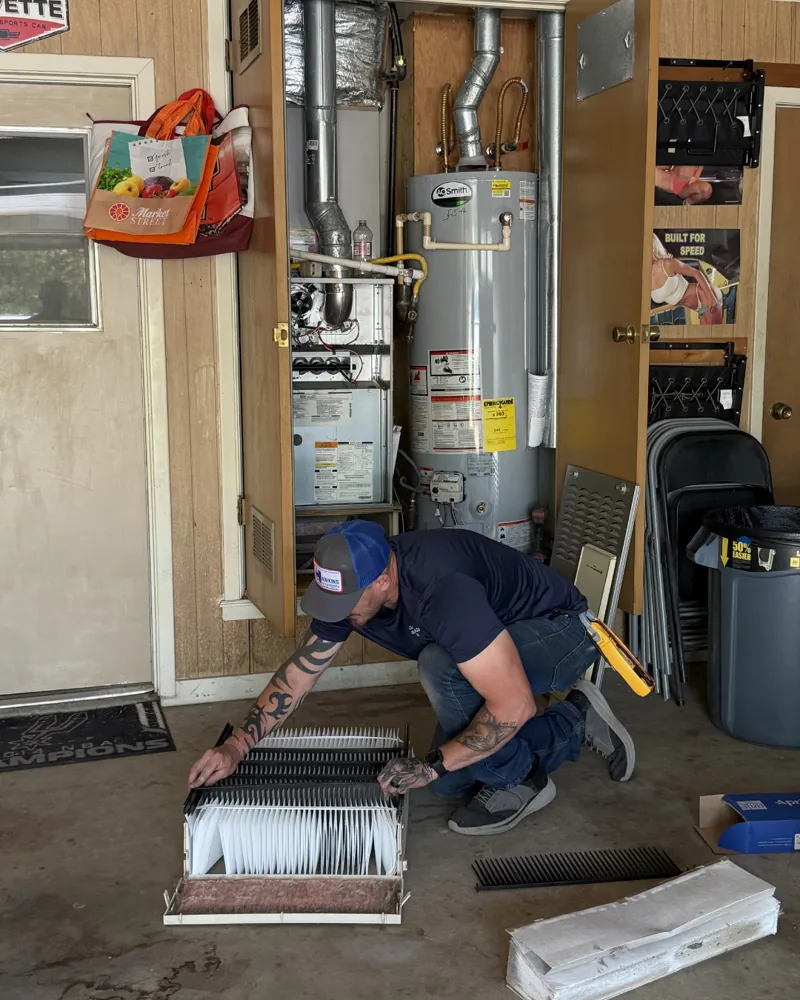
If the house will not reach the temperature you set, or the furnace runs nearly nonstop, the setting is not the cause. Start with the filter, since a clogged one restricts airflow, and our furnace filter schedule covers how often to change it. Then read our post on getting your heat ready for the first hard freeze. If the filter is fine and the house still lags, the system needs a look.
When to call for heating help in Abilene
Changing a setpoint and swapping a filter are homeowner jobs. Call us when the system runs without catching up, when a heat pump keeps showing Aux or Emergency Heat on a mild day, or when the thermostat itself is blank or behaving oddly. We will come take a look, show you what we find, and tell you what it will cost before we start. Our heating repair page covers what we handle. Call or text (325) 692-3645. Debbie or Amber will pick up during office hours, and we run 24/7 emergency service when the heat quits on a cold night.
Written by the Hawkins Air Conditioning team — family-run in Abilene since 1976. Questions? Call or text (325) 692-3645.