Quick answer: Find out now, not on the first hard freeze. A system that coasts through 50-degree mornings has to run long and hard on a 25-degree night, and that is what exposes a weak part. Abilene's first freeze averages November 11. Before then, run the heat, change the filter, check the equipment outside, and test your CO alarms.
We have been fixing heat in Abilene since 1976, and the no-heat calls follow a pattern. The first cool morning brings a few. The first night in the 20s brings a lot more, from systems that ran fine all October. Usually the part that quits was already on its way out.
A freeze and a hard freeze are not the same night
The National Weather Service calls it a freeze at 32 degrees or below and a hard freeze at 28 or lower for an extended period. The NWS office in San Angelo puts Abilene's average first freeze on November 11. The earliest on record came October 18, 1948, so October is not too early to get ready.
Our cold does not usually stick around, but it can. The same office lists Abilene's longest cold spell as 252 straight hours at or below freezing, February 9 to 19, 2021. That is ten and a half days of heating systems working around the clock.
On a hard-freeze night a furnace or heat pump runs long and often. Carrier notes that a heat pump running nearly nonstop in extreme cold can be completely normal. That long run is where a tired igniter, an overheating blower motor, or a heat pump low on refrigerant gives itself away.
A short check before the first freeze
All of this is homeowner territory, and none of it takes tools:
- Run the heat once, now. Do it on a mild afternoon with a window open. Here is what that first-run smell means, and when it is not normal.
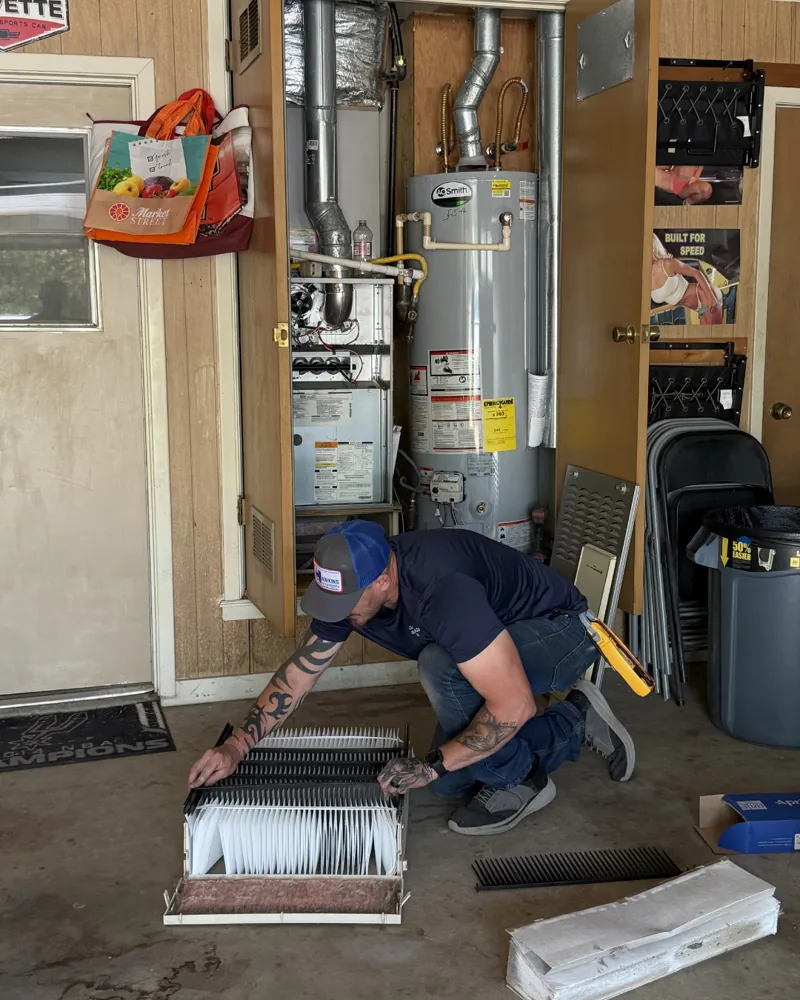
- Put in a clean filter. Carrier's owner's manual for its condensing gas furnaces says to check the filter every four weeks and warns that a dirty one can make the furnace overheat and shut itself down. A long run on a cold night is a bad time to find that out.
- Check the thermostat. Fresh batteries if it takes them, mode on heat, fan on AUTO. Carrier points out that a fan left on ON blows room-temperature air between heating cycles, which can feel like a broken furnace.
- Walk outside. Carrier recommends two to three feet of clear space around a heat pump's outdoor unit, and no gutter dripping onto it. If your furnace vents through white plastic pipes in a wall or the roof, look at the pipe ends. Carrier says the vent and air intake must stay unblocked in every season.
- Test the CO alarms. The Consumer Product Safety Commission wants carbon monoxide alarms on every level of the home and outside sleeping areas, with battery backup, tested monthly.
- Find your switches. Know which breaker runs the furnace or air handler. On a heat pump, the indoor and outdoor units are on separate breakers.
If your furnace has a small blinking status light, usually visible through a little window in the lower door, Carrier's condensing furnace manual says to write that code down before you take the door off or turn off the power. Take a short video of the light on your phone, and the technician starts with a clue instead of a guess.
High-efficiency furnaces have a cold-weather weak spot
If your furnace vents through white plastic pipe instead of a metal flue, it is a condensing furnace. It pulls enough heat out of its exhaust that water condenses, and that water drains away through a small line. Carrier's owner's manual says one installed in an unheated space that can get to 32 degrees or below needs freeze protection.
The weak spot is where the drain or vent leaves the warm part of the house. The Journal of Light Construction reported on homeowners in North Carolina, where hard freezes are rare, whose furnaces shut off on the coldest night of the 2014 winter. The condensate drains froze where they exited the house, water backed up into the furnaces, and the safety switches shut them down.
If your furnace sits in an attic or garage, or its drain runs outside, ask about it at your next heating check. Protecting that line is a small job on a mild October afternoon.
Leaving town during a cold snap? Leave the heat on, at 55 degrees or higher as the Red Cross advises. Carrier's manual says not to turn a condensing furnace off and leave it off in freezing weather unless it has been winterized, and to have an unattended one checked periodically, because some of its safety devices stay off until someone resets them by hand.
Heat pumps in a hard freeze
A little frost on the outdoor coil is normal in winter, and the unit runs a defrost cycle to clear it. Our heat pump vs. furnace guide explains the steam that makes. A coating of ice is different. Carrier lists low refrigerant, a failing outdoor fan motor, a bad defrost control, and water dripping onto the unit as causes. Do not chip it off. Carrier says never to, and to call a dealer if the unit will not clear itself.
When the heat pump cannot keep up alone, backup heat, usually electric strips in the air handler, comes on by itself and the thermostat may show AUX. Carrier calls that normal in cold weather, but AUX running above about 40 degrees outside can point to a dirty filter, a refrigerant leak, or a bad sensor.
Emergency heat, marked EM HEAT, is a setting you pick yourself. It shuts the heat pump off and runs only the backup. Carrier says to use it only if the heat pump has broken down, and to call for service. By Carrier's numbers, electric strips are 100 percent efficient against as much as 300 percent for the heat pump, so they cost far more to run.
If the heat quits on a freezing night
Carrier's furnace manual suggests a few basics before a service call: thermostat on heat and set above room temperature, breaker and furnace switch on, a clean filter, and nothing blocking the vent outside. Check those, then write down the blinking light.
If you smell gas, skip all of that. Leave the house, call 911 and Atmos Energy from outside, and call us once the gas side is clear.
A gas furnace also needs electricity for its inducer fan, igniter, control board, and blower, so a power outage means no heat. The Consumer Product Safety Commission says to run a portable generator outdoors only, at least 20 feet from the house, and never in the garage.
When to call for heating repair in Abilene
The filter, the thermostat, a look outside, and the CO alarm test are yours. Anything inside the furnace cabinet, anything involving gas, refrigerant, or wiring, and any heat pump that will not shed its ice is ours.
The best time to call is before November 11. A heating check in October means a part on its way out gets replaced on a mild weekday instead of the first night in the 20s. Here is what a fall furnace tune-up covers, and a H.A.V.E.N. maintenance plan puts that heat check on the calendar every fall.
If your heat is already acting up, call or text (325) 692-3645. The office is open Monday through Friday, 8 to 5, and Debbie or Amber will pick up, no phone tree. Emergency service runs 24/7, and no heat on a freezing night counts. Gas furnace, electric, or heat pump, we repair and service them all.
Written by the Hawkins Air Conditioning team — family-run in Abilene since 1976. Questions? Call or text (325) 692-3645.